
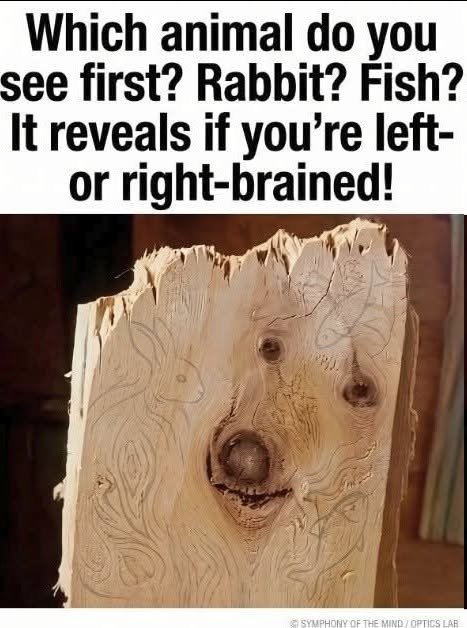
One person might notice a curved shape and immediately interpret it as a rabbit.
Someone else may focus on another outline and recognize a fish.
A third person may see a dog.
None of those reactions means the person is seeing a completely different picture. They’re simply organizing the same visual information differently.
Once You See It, You Can’t Unsee It
Have you ever struggled to find something in a hidden-picture puzzle, only for someone to point it out?
Suddenly, it’s obvious.
That’s part of the magic.
Once your brain has been given a particular interpretation, it becomes easier to recognize the same pattern again. The confusing collection of lines and shapes now has meaning.
Try looking at the puzzle again after reading all three descriptions.
You may discover that you can now see more than one animal.
Does the Animal You See First Reveal Your Personality?
Not in any scientifically established way.
These kinds of visual puzzles are often presented online as personality tests, but seeing a particular animal first isn’t enough to determine whether someone is creative, analytical, practical, emotional, or any other personality type.
Your first perception can be influenced by many things, including the image itself, visual attention, expectations, familiarity with certain shapes, and the way the image is presented.
So think of the rabbit, fish, and dog descriptions as a playful self-reflection exercise, not a psychological diagnosis.
The real value is the conversation it creates.
Try the Puzzle Again From a Different Distance
Here’s a fun experiment.
Look at the image from close up.
Then move farther away.
You may notice that the dominant shape changes.
You can also try:
Looking at the image quickly.
Looking away for a few seconds.
Looking back at it.
Focusing on the outlines rather than the center.
Looking for large shapes instead of tiny details.
Asking someone else what they see first.
The results can be surprisingly different.
Why Hidden-Image Puzzles Are So Addictive
There is something deeply satisfying about turning visual confusion into recognition.
At first, the picture feels like a collection of meaningless shapes.
Then you notice something.
Wait—is that a rabbit?
A few seconds later, the image suddenly makes sense.
That tiny moment of discovery is what keeps people searching for hidden animals, faces, objects, and other figures.
They Turn Looking Into a Challenge
Instead of passively viewing an image, you’re actively searching it.
Your attention becomes focused.
You’re comparing shapes.
You’re testing possibilities.
And when you finally recognize the hidden figure, you get that satisfying feeling of having solved something—even when the puzzle was designed specifically to make you look twice.
Can You See All Three Animals?
Now that you’ve chosen your first answer, challenge yourself again.
Can you find the other two?
If you originally saw the rabbit, search for the fish and dog.
If the fish appeared first, see whether the rabbit or dog becomes easier to recognize.
And if you saw the dog immediately, don’t stop there.
The real challenge may not be identifying the first animal.
It may be figuring out how many different interpretations you can see in the same picture.
Ask Someone Else What They See
This is also a great puzzle to share with family and friends.
Don’t tell them what you saw.
Simply ask: