
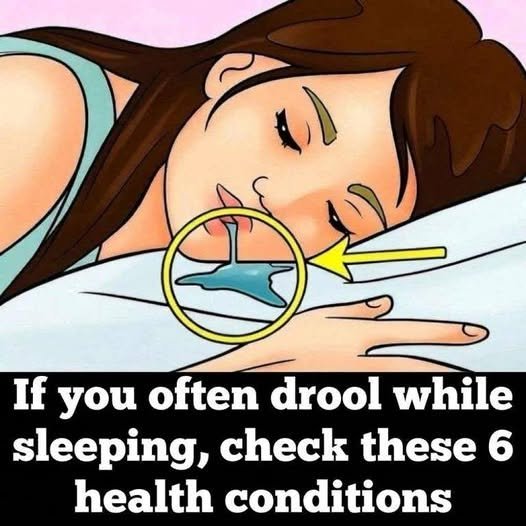
Waking up to a damp patch on your pillow is an experience that is equal parts embarrassing and inconvenient. For most people, drooling during sleep is a harmless, albeit slightly unpleasant, quirk that happens occasionally—perhaps after a particularly exhausting day, after taking certain medications, or when a heavy cold forces you to breathe through your mouth. It is a natural physiological response that we typically brush off without a second thought. However, the image presented here poses a compelling challenge to that complacency: “If you often drool while sleeping, check these 6 health conditions.”
While the occasional drool is nothing to worry about, a persistent, chronic pattern of excessive drooling at night is a different story. The human body is an intricate and highly responsive system. When the delicate balance of our bodily functions is disrupted, the body often communicates this distress through subtle, and sometimes messy, symptoms. Frequent nocturnal drooling can be the first visible sign of an underlying issue, ranging from airway obstructions and digestive problems to neurological changes and medication side effects.
This comprehensive guide will delve deep into the anatomy of sleep, the mechanics of saliva production, and the critical health conditions that can manifest as a wet pillow. By understanding these six potential root causes, you can stop merely wiping away the symptom and start addressing the underlying reasons your body is producing such an undeniable signal.
The Science of Saliva and Sleep: Why Do We Drool?
Before exploring the health conditions, it is essential to understand the mechanics of drooling. Saliva is a complex and vital fluid produced by the salivary glands. It aids in digestion, protects the teeth from decay, lubricates the mouth, and facilitates swallowing.
During waking hours, we produce roughly one to one-and-a-half liters of saliva daily. We also unconsciously swallow it hundreds of times a day. However, when we sleep, our body’s physiological functions change dramatically. Saliva production naturally decreases, and the swallowing reflex—which is a complex neuromuscular action—slows down significantly.
Drooling occurs when there is an imbalance between saliva production and its clearance. If the mouth is open during sleep (due to mouth breathing), gravity simply takes over. The saliva pools near the lips and eventually spills out onto the pillow. Alternatively, if the swallowing mechanism is impaired, the body cannot clear the saliva effectively, leading to a buildup that escapes during deep sleep stages.
While sleeping position (side or stomach) and deep sleep phases are common benign causes, chronic, heavy drooling warrants a closer look at these six specific health conditions.