

Do You Have This Tiny Hole Near Your Ear? Here’s What It Really Means
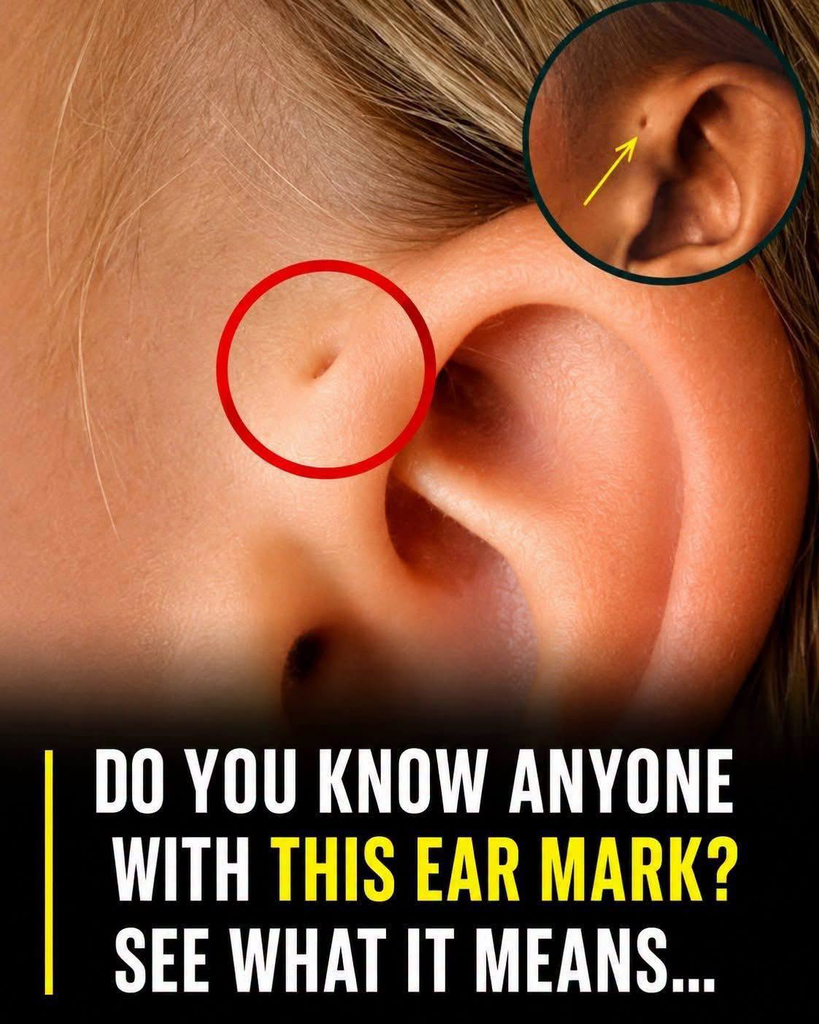
The tiny hole near the ear, circled in red in the image, has been the subject of myths and folklore for generations. In some cultures, it is called a “wealth hole” or “smart hole,” believed to signify good fortune and intelligence. The viral post asks if you know anyone with this mark, hinting at a hidden meaning. The truth is far more grounded in science. This small opening is a congenital condition known as a preauricular pit or preauricular sinus. It is a benign malformation that forms during fetal development, and for the vast majority of people who have it, it causes no problems at all. However, understanding what it is and how to care for it is important, because this tiny tract can sometimes become a source of infection.
What Is a Preauricular Pit?
A preauricular pit is a small opening or dimple located just in front of the ear, typically near the upper part where the ear attaches to the face . It is not a piercing or a scar; it is a congenital trait, meaning a person is born with it. The pit is the visible entrance to a narrow tract or sinus that runs beneath the skin. This tract can be short and simple, or it can be long and branched, extending deeper into the surrounding tissue .
The condition is surprisingly common. Estimates suggest it affects between 0.1% and 0.9% of the general population in the United States, though it is more prevalent in certain groups . A study of children in British Columbia found a prevalence of 2.4%, with significant ethnic variation: Asian children had the highest rate at 6.6%, followed by African American children at 4.5%, Middle Easterners at 3.4%, and Caucasians at 1.2% . It often appears on only one side, most frequently the right ear, but it can be bilateral in 25% to 50% of cases .
Why Does It Form?
The pit is the result of an error during embryonic development. During the sixth week of gestation, the structures that will become the outer ear begin to form from the first and second branchial arches. If these tissues do not fuse completely, a small gap or tract is left behind, creating the preauricular sinus . This is why the condition is classified as a congenital malformation, though it is a minor and common one.
The Myths vs. The Medical Reality
The viral framing of this feature often leans on cultural superstitions. In some Chinese traditions, the pit is called a “granary” or “wealth hole,” and it is considered a sign of prosperity and a life of plenty. Other folklore calls it a “smart hole,” suggesting the person possesses above-average intelligence .
Medical science does not support any connection between a preauricular pit and a person’s intelligence, wealth, or destiny. It is simply an anatomical variation, like having dimples or attached earlobes. The pit itself has no bearing on a person’s character or future. In fact, historical records show that in some medieval European societies, these pits were viewed with suspicion and fear, a stark contrast to the positive superstitions found elsewhere .
When Should You Be Concerned?
For most people, the preauricular pit is a completely asymptomatic curiosity. It requires no treatment and causes no discomfort . The problem arises only if the pit becomes infected.
Signs of Infection
The tract of the sinus is lined with skin cells that can shed. These cells, along with oils and debris, can accumulate within the tract. If bacteria enter the opening, they can thrive in this trapped material, leading to an infection . You should watch for these signs around the pit:
- Redness, swelling, and warmth in the area.
- Pain or tenderness when touched.
- Pus or a foul-smelling discharge coming from the opening .
- A slow-growing, painless lump near the pit, which could indicate a cyst .
If any of these symptoms appear, it is important to see a doctor. An infection may require antibiotics, and if an abscess has formed, it may need to be drained .
The Golden Rule: Do Not Squeeze
The most important piece of advice for anyone with a preauricular pit is to leave it alone. Do not squeeze, pick, or try to extract any material from the hole. This is the most common way to introduce bacteria and trigger an infection . The small amount of white, cheesy substance that occasionally emerges is normal epithelial debris, and it is best left undisturbed or gently wiped away during regular washing. If you notice discharge, simply clean the opening gently and avoid blocking it, which could lead to a buildup and infection .
Treatment and Prevention
If the pit remains asymptomatic, no medical intervention is needed. The focus should be on gentle hygiene. When washing your face or showering, simply clean the area around the ear with mild soap and water, and pat it dry gently. Avoid harsh scrubbing or inserting anything into the opening.
If a person experiences recurrent infections despite good hygiene, a doctor may recommend surgical removal of the sinus tract. This is a minor procedure that eliminates the problem by removing the entire tract beneath the skin, preventing future infections . The surgery is typically performed after any active infection has been treated and has resolved. Recurrence rates after surgery vary, but complete excision is the goal to prevent the problem from returning .